A First Turn on the Touchline: Helping Without Playing
Explore helping at local football without playing: learn what to observe, how to ask before taking on a task, and how to find a comfortable first role.
What can you do at a local football session if you want to be involved but would rather not play? Helping without playing can begin with a quiet visit, a little observation and a question to the person organising the activity. You do not need to arrive with a job title or promise to volunteer every week.
At a grassroots club, useful work is often less visible than the match itself. Someone may be welcoming families, keeping an eye on the entrance, sorting bibs or making sure the next group knows where to go. The right first task is not necessarily the most exciting one; it is one that the organiser needs, that you understand and that feels manageable to try.
What does helping without playing involve?
It means contributing to a football activity without taking part as a player. That could mean assisting around a junior training session, supporting a community kickabout, helping at a club event or doing a small administrative task. Some roles happen pitchside; others are indoors or occasional.
There is a useful difference between being nearby and being responsible. A visitor can watch how a session works, while a volunteer may be asked to look after equipment, welcome people or support a named organiser. Knowing which position you are in helps prevent confusion. If nobody has agreed that you are responsible for something, do not assume that responsibility on your own.
Non-playing involvement does not have to mean coaching. Coaching has its own expectations and may require relevant training or checks, especially in youth football. Clubs also need practical help that does not involve giving players instructions, making selection decisions or supervising children independently.
How can you tell what help is needed?
Arrive with time to observe rather than trying to spot a problem and fix it immediately. Notice the flow of the session: who welcomes people, where equipment is kept, how players move between activities and who seems to be coordinating changes. You are looking for a clear gap, not judging how the club should be run.
Listen for small requests that the organiser already makes. They may mention that someone is collecting cones after training, that a sign-in table needs cover or that a club gathering needs a hand setting out chairs. A stated need is a better starting point than guessing what would be useful.
If you cannot see an obvious task, that is not a reason to invent one. Ask the organiser what tends to need attention, or whether there is a suitable way to observe for now. At a busy session, they may not have time for a conversation until afterwards. A brief greeting and a request to speak later can be more helpful than interrupting while they manage players.
What should you ask before taking on a task?
Ask the person responsible for the activity, not whichever player or parent happens to be closest. A simple question works: “I’d like to help, if there’s a task that would be useful. What would you like me to do?” Then let them explain the task, the boundaries and who you should check with if something is unclear.
Make the offer specific enough to answer. You might say you are available to help at this session, can arrive early next week, or would prefer an occasional role. You can also name a task you are comfortable trying, while making clear that you are open to the organiser’s suggestion.
- Ask who will show you what to do.
- Check where to find and return any equipment.
- Find out when the task starts and when it is finished.
- Ask who to contact if you cannot attend or need to stop.
- Clarify whether you are expected to speak with players or families.
These questions are not a demand for a formal job description. They help both sides understand the arrangement. If the answer is uncertain, agree to wait until the organiser can clarify rather than taking on a task whose limits are unclear.
Which first role might suit you?
Start with the kind of interaction you find comfortable. If you enjoy brief conversations, greeting people at an open community session may suit you. If you prefer a practical task, preparing or collecting equipment under someone’s direction may be a better fit. If you like quiet, focused work, a club may need help with a noticeboard, a simple sign-in process or event preparation.
Some possibilities include:
- Welcoming visitors and directing them to the organiser.
- Helping sort bibs, cones or balls before and after a session.
- Setting out chairs or refreshments at a club gathering.
- Supporting an event table, such as handing out information.
- Taking on a small administrative task agreed with a committee member.
Each task has boundaries. Sorting equipment does not make you responsible for deciding how a drill should run. Welcoming families does not make you the person to answer questions about safeguarding, fees or team selection. When a question falls outside your role, direct it to the named organiser rather than guessing.
What if you are nervous or do not know football well?
You can say so plainly. A club should be able to explain a suitable task without assuming that you know the rules, local routines or the names of every piece of equipment. If you are unsure what someone means, ask them to show you or use ordinary language to check your understanding.
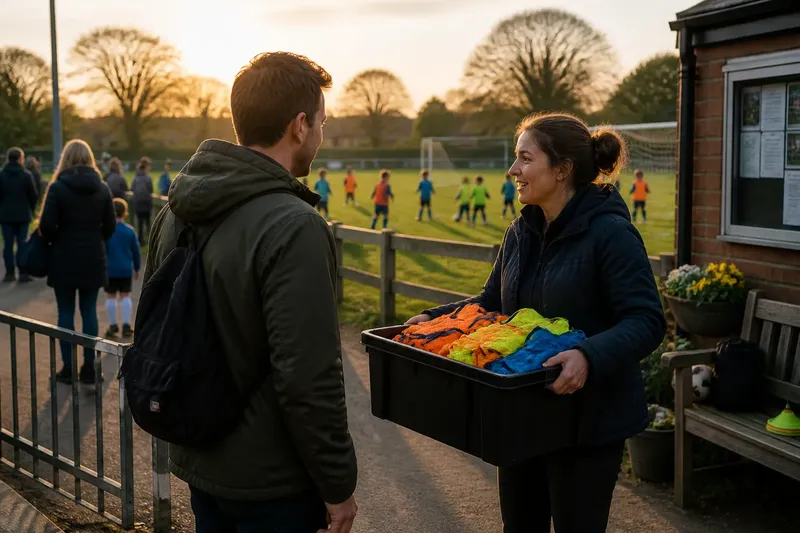
Say you visit an imagined under-10s training session and notice an organiser carrying a box of bibs while greeting arriving families. You ask whether they would like help, and they suggest carrying the box to the equipment area and then standing with them at the welcome point. The expected visible result is that the organiser can greet people with less to carry, while you learn the session’s routine without being asked to supervise children or lead training.
You can also choose to watch first. Tell the organiser you are exploring ways to contribute and ask whether there is a suitable session to observe. A clear explanation of what visitors may do, where they should stand and whom to approach makes that first visit less awkward.
How can you try a role without overcommitting?
Agree on a small trial that has a clear beginning and end. That might be helping with one session, supporting a single club event or trying an occasional task before discussing anything ongoing. A short, defined arrangement gives you and the organiser a chance to see whether the task fits.
Before you begin, agree how to communicate. Find out whether the club uses email, a group message or a named contact for changes. If you need to cancel, let that person know as soon as you can; do not assume another volunteer will cover the task.
Afterwards, tell the organiser what felt comfortable and what did not. You might want to continue with the same task, try something quieter, or leave it there. A useful first turn does not have to lead to a permanent commitment. It can simply make the club’s everyday work easier while giving you a clearer sense of where you might fit.
What questions do first-time volunteers ask?
Can I help if I have never played football?
Yes, many practical and welcoming tasks do not require playing experience. Explain what you are comfortable doing and ask the organiser to choose a suitable task.
Do I need to volunteer every week?
Not necessarily; clubs may have occasional tasks as well as regular roles. Say clearly what time you can offer and ask whether that matches a current need.
Can I help with a children’s team straight away?
Do not assume that a casual offer makes you ready to supervise or work directly with children. Ask the club about its role boundaries, safeguarding arrangements and any required checks before agreeing to a child-facing responsibility.
What if the organiser says there is nothing to do?
Thank them and ask whether you may check back at another session or contact them later. There may be no suitable task that day, and waiting for a clear request is better than taking over work without permission.
How do you know whether the first turn worked?
Look for a simple, shared understanding: the organiser knew what you were doing, the task stayed within its agreed limits, and you could ask for help when needed. The task may be modest, but its purpose should be clear to both of you.
Helping without playing at a local football club is often less about finding a permanent role than making a sensible first connection. Observe what the session needs, ask before acting and choose a task you can complete comfortably. That approach lets you contribute without stepping into responsibilities nobody has given you.